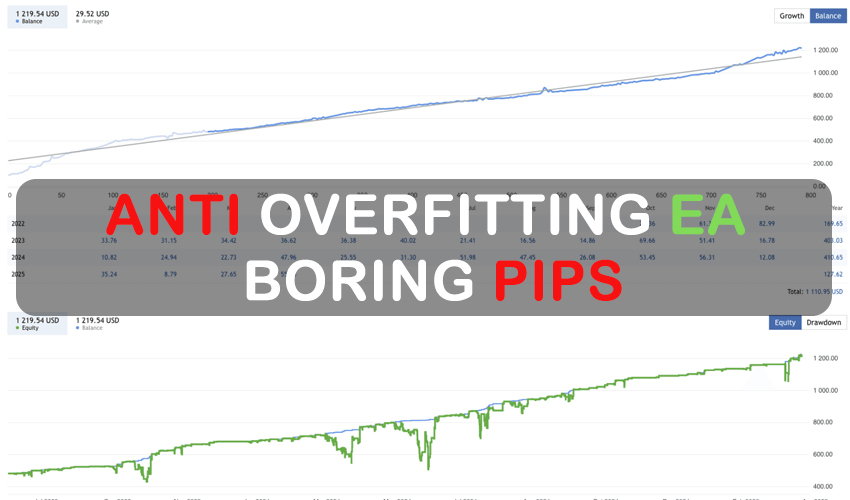
Boring Pips EA is designed to avoid overfitting a common issue in many automated strategies. Using a three stage optimization process, it aims for more stable live performance. Despite marketing claims of “AI” and “deep learning” in Anti OverFitting EA, its core strategy appears to rely on classic methods such as momentum, supply and demand zones, and Fibonacci levels.
In the world of automated trading, it’s common to come across EA that boast near perfect backtest results. Yet, when it comes to live trading, many of them underperform or completely fail. This discrepancy often points to a common issue: overfitting.
The developer of the Boring Pips EA highlights this:
“Have you ever wondered why most expert advisors are not effective in live trading, despite their perfect backtest performance? The most likely answer is Over-fitting.”
According to the developer, many EAs are programmed to fit historical data too closely. This tight alignment can make the strategy look brilliant in the past but renders it ineffective in real-time, unpredictable environments. Some developers might not even recognize this flaw; others may knowingly use overfitting as a way to make their EA look better than it actually is in order to impress buyers.
Core Strategy and Logic
Anti OverFitting EA combines several classic trading concepts to identify entry opportunities across correlated currency pairs. Its approach is multi-layered, scanning for conditions across 4 timeframes before executing:
- Momentum Analysis – The EA monitors momentum slowing down in potential reversal zones. Traders familiar with momentum-based entries will find similarities to systems like the GerFX Momentum Capture EA, though the Boring Pips EA applies this concept specifically to correlated currency pairs rather than event-driven trading.
- Supply and Demand Zones – The system scans for potential zones where prices may reverse, identifying areas of institutional buying or selling pressure. This is the same foundational concept used by dedicated tools like the Supply Demand EA, but integrated here as one component of a broader multi-factor entry system.
- Fibonacci Retracement – Fibonacci levels are used to gauge potential reversal points within the broader trend structure. Traders who rely heavily on this approach may also want to explore the Fibot Fibonacci EA for a comparison of Fibonacci-centric strategies. You can also calculate key Fibonacci levels manually with our Fibonacci Calculator.
- Multi-Timeframe Confirmation – Entries are confirmed across 4 timeframes, filtering out noise and reducing false signals.
Based on observation, the system focuses on correlated currencies like AUD, CAD, and NZD, which often move in similar ways and can present unique trading setups. This correlation-based approach shares DNA with systems like the Smart Correlation Hedge EA, which also exploits currency pair relationships, though that EA focuses more on hedging, while Boring Pips targets directional momentum entries.
Key Features Summary
- Strategies used – Momentum, supply/demand zones, Fibonacci retracement, and AI-based momentum detection
- Currency pairs – Multi-currency (likely focusing on AUD, CAD, NZD correlations)
- Risk Controls – Includes take profit (with trailing option), fixed stop loss, optional grid and martingale
- Manual options – Traders can manually stop entries or close all positions
- Single Chart Setup – Can trade multiple instruments from one chart
Recommendations
- Minimum account balance of 100$.
- It is made to work on AUDCAD, AUDNZD, and NZDCAD.
- It works on M5. (Work on any TimeFrame)